
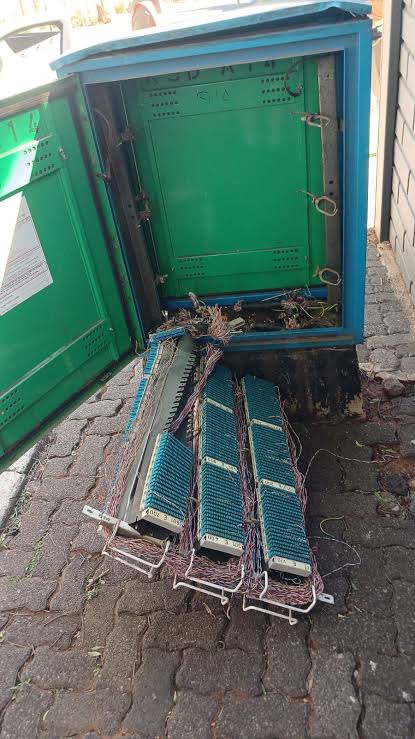
The way to secure a fibre optic housing is to stop worrying about the glass and start watching the box. Thieves rarely want the fibre itself. They want the batteries, the copper, and whatever else is sitting in the cabinet, and the damage to your network is just collateral. An alarm that tells you the moment a door opens or the power drops gives you a fighting chance before the customers start phoning.
Picture it. It’s 2 AM, a node cabinet on the edge of town gets popped open, the battery bank walks off, and you only find out when forty subscribers lose their connection at breakfast. Ever had that call? Then you know the cost isn’t the battery. It’s the day of lost uptime, the truck roll, and the customers who now wonder about you.

Do thieves actually steal fibre?
Not much, no. Openserve’s own people have said as much: fibre is seldom stolen or damaged by thieves because it has no resale value, and they’ve been replacing copper with fibre for exactly that reason (TechCentral, 2021). Good news, sort of.
The catch is that fibre networks aren’t just glass. They need power, and power means batteries, rectifiers, and sometimes generators. All of it is sitting in a cabinet, a roadside housing or a small equipment room, and that’s what gets targeted.
The numbers from the regulator’s latest ICT sector report make this plain. Theft-related costs for operators jumped 189%, from R69.59 million to R201.48 million. Battery spending roughly doubled to R387.7 million, and generator spending to R426.8 million (Engineering News). Those are national operator figures, and most of that is cell sites. But the same thieves, with the same bakkies, work the same roads.
Telkom has also said copper theft is a bigger problem than most people realise, citing an industry forum estimate of R7 billion a year, and more than 3,000 suspects apprehended between July 2017 and December 2023 (TechCentral). The point isn’t the exact figure. It’s that the criminals are organised and they know where the metal is.
Why doesn’t a padlock cover it?
Because a padlock tells nobody anything. It just delays the person with a grinder by a minute or two. Here’s where we see the gaps on network sites:
- Nobody’s told. A cabinet gets opened and no one finds out until something stops working.
- Power failure looks like an outage. Is the cabinet dead because of load shedding, a cut cable, or a stolen battery? Without a separate alert, you’re guessing.
- Remote sites with no Wi-Fi or landline. The alarm has to talk over cellular, and it has to keep talking when the mains is gone.
- One person gets the SMS. And they’re asleep, or out of range.
- Big monitoring platforms don’t suit small operators. A rural ISP with twelve cabinets isn’t buying a full managed control room.
Look, the large operators can afford heavy systems and guards. A wireless ISP in the Karoo or a fibre start-up in a small town can’t, and those are the people losing sleep.
How does Fine Automation help secure a fibre housing?
We build wireless alarms that don’t need much around them to work. For a cabinet or small equipment room, that means:
Cellular, no router. Our alarm connects over 4G LTE with a 2G fallback. There’s no Wi-Fi to drop and no landline to cut.
Long battery life. The core unit is rated for 14+ days of runtime in normal mode, and passive sensors and door guards run for around five years on their batteries. Fewer trips out to a remote cabinet just to swap a cell.
WhatsApp to your team. When the alarm triggers, the message goes to the people you’ve set up, up to six of them, not one tired person. Think the on-call technician, the NOC, the site owner and your security response company. You can read how that works on our real-time WhatsApp alerts page.
Outdoor sensors where you need them. Outdoor passive sensors are rated IP55, which helps for a compound or a cabinet with an exposed approach. There’s also a 15W siren and a tamper box housing for the add-ons, if you want something loud and visible.
One screen for many sites. FineTrack, our online control room, lets you monitor and control multiple alarms from a browser. Ten cabinets shouldn’t mean ten apps.
And on the power side, our solar protection and monitoring solution watches batteries and sends a WhatsApp alert when something needs attention. For a cabinet running off a battery bank, knowing the bank’s gone flat before the network drops is half the job.
What should an installer put on a fibre site?
Here’s what we’d suggest, based on where things typically go wrong:
- Door or lid first. If someone opens the housing, you want to know immediately.
- Approach second. An outdoor passive sensor gives you a heads-up before anyone reaches the cabinet.
- Watch the power. Mains failure, a dead battery bank, or a dropped input is often the first sign of trouble.
- Alert more than one person. Two or three numbers at least. A missed message shouldn’t mean a missed site.
- Test the signal before you commit. Boring, but the one people skip.
Our business and factory alarm system is built around securing multiple locations with WhatsApp alerts and remote control, which suits a spread-out network. If you’re comparing options, our guide to the best wireless alarm systems in South Africa goes through the main choices on connectivity and battery life.
FAQ
What is fibre optic housing security? It’s the alarm and monitoring setup that protects the cabinets, nodes and small equipment rooms that fibre networks run on. The goal is to know straight away when one is opened, approached or loses power, so someone can respond before it turns into an outage.
Is fibre cable itself stolen? Rarely, since it has no scrap value. What gets stolen is usually the copper, the batteries and other equipment around it. That’s why the housing and its power supply are what you protect.
Will the alarm keep working if the power fails? It runs on a battery backup, and the core unit is rated for 14+ days in normal mode. It uses its own cellular connection, so a dead router doesn’t switch it off.
How many people can get alerts? Up to six numbers on WhatsApp. That’s enough for a technician, a supervisor, your NOC and a response company, with room to spare.
Does it work where signal is weak? It connects on 4G with a 2G fallback, which helps, but nothing cellular works with no coverage. Check the signal at the site first, and talk to us if it’s marginal.
Looking after networks for your customers?
If you’re an installer or security shop with ISPs, fibre contractors or estates with their own network cabinets on your books, this is a gap worth filling. If you’re ready to offer your customers better protection for their infrastructure, get in touch about becoming a verified installer and ask us about bulk pricing. We’ll help you spec the first site.