
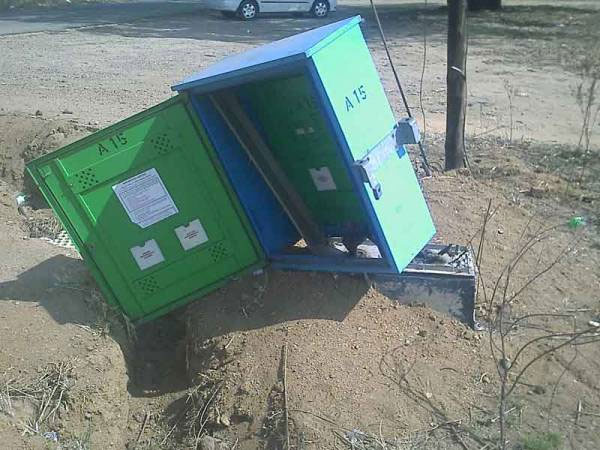
The best protection for a cell tower site is knowing within seconds that someone’s on it, or that its power has failed, so a response team can get there before the batteries are gone. A fence and a padlock only slow thieves down. An alarm that sends a WhatsApp message to the people who can act is what actually changes the outcome.
Think about the usual pattern. A site sits on a hill outside Danielskuil or Kuruman, nobody’s within 20 kilometres, and the first you hear of a break-in is when the network drops and the complaints roll in. By then the batteries are on a bakkie.

What are thieves actually after at a base station?
Mostly the stuff that’s easy to sell. Batteries are the big one. Copper cabling comes next, and in the past few years generators and diesel have joined the list.
The numbers back it up. The regulator’s latest ICT sector figures, reported by Mining Weekly in May 2026, show theft-related security costs for operators jumping 189%, from about R69.6 million to R201.5 million. Over the same period, spending on replacement batteries roughly doubled to R387.7 million, and generator spending doubled to R426.8 million. Vandalism costs actually fell, which the report puts down partly to better surveillance and faster response. Take that as a hint about what works.
Courts are taking it seriously too. In April 2025 a man was handed 47 years by the Kimberley Regional Court for stealing batteries from tower masts around Delportshoop and Danielskuil in the Northern Cape (ITWeb). That’s a sentence nobody expects, and it tells you how seriously the damage is being treated.
Why isn’t a normal alarm enough for a tower site?
Because tower sites are nothing like a house, and honestly, most alarms aren’t built for them. Here’s where the gaps usually show up:
- No mains, or unreliable mains. If the alarm panel dies with the grid, you lose protection exactly when power is cut, which is what thieves often do first.
- No Wi-Fi, no landline. Remote sites rely on cellular. An alarm that needs a router is useless out there.
- Alerts that go nowhere. A siren on an empty hilltop doesn’t help anyone. Someone has to be told, and told fast.
- One person gets the message. If they’re asleep or out of signal, the alert just sits there.
- Too many different systems. Security guards, power monitoring and site access logs end up on three separate screens.
Large operators have the budget for fully managed control rooms, and they’ve spent billions on this. The smaller players are a different story: infrastructure companies, tower contractors, rural ISPs with a handful of masts, and the security firms who look after them. They need something that’s affordable, wireless and quick to deploy.

How do Fine Automation alarms protect a remote site?
We build wireless alarms and controllers that are designed to run without a lot of infrastructure around them. Here’s what that means in practice.
Cellular, not Wi-Fi. Our panels connect over 4G LTE with a 2G fallback, using SoftSIM technology instead of a physical SIM card. There’s no router to fail and no SIM to run out of airtime.
Battery backup measured in days. The control unit is rated for 14+ days of runtime in normal mode, and the 7Ah backup battery is good for 10+ days without an alarm being triggered. A site that loses grid power, or has its supply cut, stays protected well past the first night.
WhatsApp alerts to up to six people. The moment the alarm triggers, the message goes to everyone you’ve set up: the site supervisor, the technician on call, your control room, the security response company. Each person opts in once and gets their own key. If the WhatsApp service is ever being upgraded, the system falls back to SMS automatically and switches back afterwards.
Sensors that outlast the panel. Passive infrared sensors and door guards run for around five years on their batteries, and outdoor passive sensors for 4+ years. For installers, that means fewer call-outs to remote places just to swap a battery.
One online control room. Our free online platform, FineTrack, lets you monitor and control your alarms from a browser. If you’re looking after ten sites, you don’t want ten separate apps.
And for the power side, our solar protection and monitoring solution tracks battery levels and sends a WhatsApp alert when something needs attention. A flat battery bank that you don’t know about is the same as no backup at all.
What does a good setup look like in the field?
Here’s what we’d suggest to an installer speccing a site, based on what actually goes wrong:
- Protect the shelter or cabinet door first. That’s where the batteries are, so that’s where you want the earliest warning.
- Cover the compound. Outdoor passive sensors give you a heads-up before anyone reaches the equipment.
- Monitor power, not just intrusion. A mains failure or a battery dropping off is often the first sign of trouble, sometimes before anyone’s on the site.
- Alert more than one person. Put at least two or three on the list, so a missed message isn’t a missed site.
- Check the signal. Before you commit to a site, test cellular coverage. It sounds obvious, and it’s the step people skip.
The business and factory side of our range is built to secure multiple locations with WhatsApp alerts and remote control, and that’s the logical starting point for a multi-site job. If you’re weighing up what’s out there, our guide to the best wireless alarm systems in South Africa compares the main options on battery life and connectivity.
FAQ
What is a cell tower protection alarm? It’s a security system installed at a base station or tower compound that detects intruders, door openings or power failures and alerts you straight away. The good ones run on cellular and have their own battery backup, because the site might have neither Wi-Fi nor reliable mains.
Can an alarm stop battery theft? An alarm won’t physically stop a determined thief, but it shortens the time they have. When the alert goes to a response team within seconds, the difference between “caught in the act” and “found it empty on Monday” is often just minutes.
Will the alarm work if the power is cut? Yes, as long as it’s on battery backup. Our control unit is rated for 14+ days in normal mode, and the backup battery for 10+ days without an alarm trigger. It uses its own cellular connection, so a dead router or landline doesn’t matter.
How many people can receive alerts? Up to six numbers per device. That’s usually enough for the site supervisor, a couple of technicians, your control room and a response company.
Does it work in areas with weak signal? It connects on 4G with a 2G fallback, which helps, but no cellular product works where there’s no coverage at all. Test the signal at the site before installing, and talk to us if it’s marginal.
Securing sites for your customers?
If you’re an installer or security shop with telecom contractors, tower owners or rural ISPs among your clients, this is a good gap to fill. If you’re ready to offer your customers better protection for their remote sites, get in touch about becoming a verified installer and ask us about bulk pricing. We’ll help you spec the first one.